
South Africa Chapter


My days currently consist of horses, wildlife, a whole lot of dust, and an adrenaline level somewhere between “absolutely incredible” and “what am I actually doing here?”
Because honestly: How often do you get chased by elephants while sitting on horseback or followed by curious young lions? How often do you ride past enormous crocodiles, wake up at night to the roar of lions or the calls of hyenas? Or wake up in the morning to the surprise that a hyena has raided the kitchen during the night or that lions have walked right past your window? And when does a rhino come so close to a horse that it looks as if the two of them are about to kiss? What I get to experience here regularly sends my nervous system into a little adrenaline rush.
South Africa is actually much colder during the months I am here (May to July) than I expected. At night, temperatures can easily drop below 10 degrees, while during the day the thermometer can rise to 30 degrees. It’s quite a crazy contrast and something I’m definitely not used to. There is no heating here, and most of the buildings are designed with open spaces. The layering principle and my heated blanket have therefore become my best friends by now. At the moment, everything is incredibly green because of the heavy rainfall earlier this year, which also affected this region. The river that we couldn’t cross for weeks has finally dropped enough after more than six weeks without rain that we can now cross it again with the horses.
By the way: While writing this, I realise that I should probably first explain what I am actually doing here in South Africa. So, let’s go back to the beginning.
Since May, I have been in South Africa, near Hoedspruit and around 80 kilometres from Kruger National Park. Here, I am supporting a safari lodge as a volunteer that offers horse safaris. And not just ordinary horse safaris — these are safaris where guests actively search for the Big Five. This is actually quite unique. Because when we find out where, for example, the lions are located, we ride directly towards them. Most other safari operators do the opposite and avoid these areas.
The idea here is to observe wildlife respectfully in its natural environment — and to do so from the back of a horse. My tasks are incredibly varied. I prepare the horses for the rides, join safaris as a backup rider, train horses, clean tack, care for the horses, feed them, and help serve dinner to the guests in the evenings.
A short explanation of the backup rider role:The backup rider rides at the very back of the group, provides additional safety during the rides, keeps the group together during wildlife sightings, and occasionally guides the group away from sightings if the guide needs to create some distance from the animal as a precaution or observe it for a longer period of time. So, it is a different role from the one I had in Namibia. There, I actually led the rides myself, as the reserve only had leopards as the main predators.
What exactly are the Big Five?
The Big Five consist of the lion, leopard, buffalo, elephant, and rhinoceros. The term originally comes from the era of big-game hunting and refers to the animals that were considered the most difficult and dangerous to hunt on foot.
These animals are known for their strong defensive reactions and may attack when they feel threatened, are injured, or are cornered. The term therefore has nothing to do with their size or their “ranking” in the animal kingdom. And these are exactly the animals we regularly experience here — from the back of a horse.
And yes, my adrenaline rises incredibly high when we suddenly have a lion sighting.
And when the young lions find us interesting, become curious, and start following us, my adrenaline level goes even higher. On one hand, there is this incredible fascination. You are sitting on a horse and watching one of the most impressive predators in the world in its natural environment. You see every movement, every look, every small change in their body language. At the same time, I have to make sure that the guests stay close together as a group, that my horse does what I need it to do in that moment, that I follow the guide’s instructions, and that I can safely lead the group away from the situation if necessary. I honestly don’t even know how to describe this feeling. On one hand, it is absolutely incredible to experience this predator up close, to see how it behaves, and to watch it follow us with its eyes. At the same time, it is somehow intimidating because you know what these powerful predators are capable of and how they hunt. It is a mixture of awe, excitement, amazement, happiness, and a feeling of panic — all at the same time.
It is similar with elephants. As long as they accept our presence, it is simply incredible to observe them. These enormous animals often move much more quietly and gently than you would expect. However, as soon as an elephant decides that it no longer wants us nearby, the entire atmosphere can change completely within a few seconds. That is when it is important to stay alert, react quickly, and give the animals the space they need.
My personal favourite wildlife sighting is the white rhinoceros. They are such gentle and calm animals. They peacefully graze along, and sometimes they come so close to the guide’s horse that it looks as if they are about to give each other a little kiss on the nose.
Every time I experience a sighting like this, I get goosebumps because it is truly something special to be able to observe these endangered animals from such a close distance while they remain so peaceful.
With buffalo, it depends on whether we encounter a lone male or a group of females. A single old bull should be approached with caution.
The rule here is: keep your distance, stay alert, always give the animal enough space, and choose a different direction than the buffalo.
The only animal that I am still missing from my horseback wildlife experiences is actually the leopard. I have already been able to observe one from a vehicle, but so far not yet from horseback. Apart from that, I have now experienced all of the Big Five from the back of a horse. But no matter which animal you encounter — whether it is an antelope, giraffe, zebra, or one of the Big Five — it is always beautiful and a privilege to experience wildlife in its natural environment and to move through this world as an observer.
Sometimes you don’t even have to leave the lodge to see animals. You simply sit on the terrace and suddenly a buffalo walks past or a herd of elephants moves through the river. Monkeys are constantly everywhere — on the roofs, in the trees, on the terrace, or in the stables. Baboons and impalas regularly wander into the horse paddocks, bushbucks come into the garden, and every now and then giraffes stop by as well. And sometimes even the lions come as far as the lodge. It is quite crazy how quickly you get used to wildlife simply being part of your everyday life. Just the normal bush madness.
Every now and then, I also need a little break from the bush. As much as I love life in the wilderness and enjoy the daily horse safaris, I occasionally feel the need to escape the reserve for a few hours and head to Hoedspruit. Just to get out for a while, enjoy a good coffee, go shopping, wander through a store, or simply experience a little sense of everyday life again.
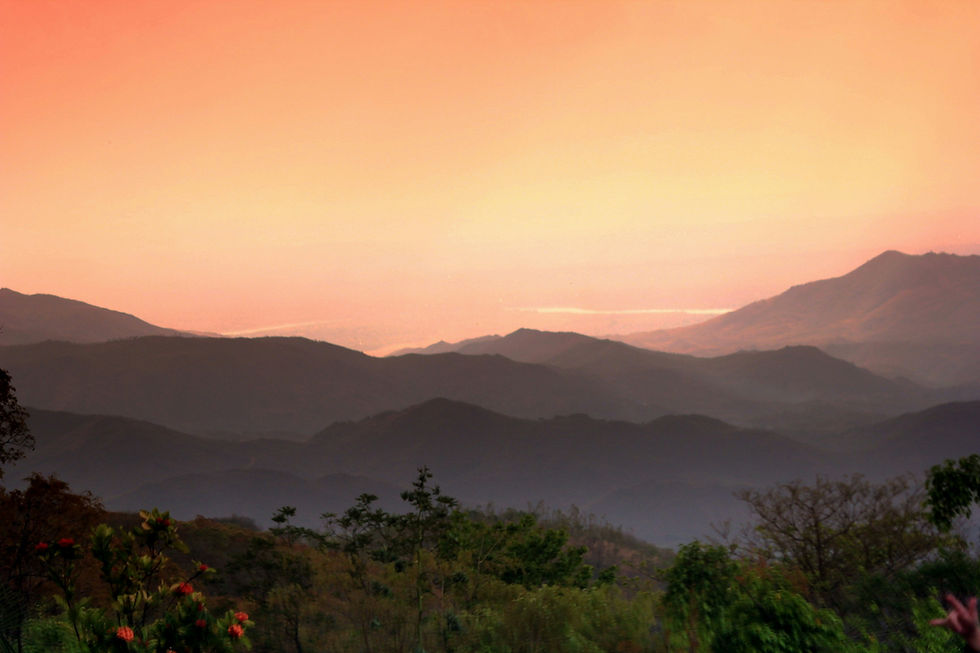
Hoedspruit is located in the northeast of South Africa and is often referred to as the gateway to Kruger National Park. The small town is surrounded by private game reserves, farms, and bushland, while also serving as a starting point for many safari adventures. What impresses me every single time, however, is the scenery. No matter where you are, the Drakensberg Mountains rise somewhere on the horizon. The Blyde River Canyon, one of the largest green canyons in the world, is located very close by.
What I also find particularly fascinating is how much focus there is here on nature and wildlife conservation. In the surrounding area, there are several projects that care for injured or orphaned wildlife and work to protect animals and their habitats.
Topics such as poaching, conservation, and the coexistence of humans and wildlife are not abstract concepts here — they are part of everyday life.
One project that especially impressed me is “Down to the Wire.” The project collects wire snares that are illegally placed in the bush by poachers and transforms them into jewellery, sculptures, and works of art. Something that originally caused suffering and killed animals is turned into something new and meaningful. The proceeds go back into anti-poaching projects and wildlife protection efforts. I think the idea behind it is incredibly powerful. If you would like to learn more about the project: Down to the Wire
Another well-known organisation in the region is the Moholoholo Wildlife Rehabilitation Centre, where injured, poisoned, or orphaned wildlife is cared for and, whenever possible, released back into the wild. Places like these show how much dedication and effort goes into protecting the animals we so naturally admire during safaris.
Beyond all the safaris, horses, and wildlife, there is something else that has been on my mind. I keep catching myself thinking about what my life will look like once all these volunteer projects are over. Because as beautiful as this time is, at some point this chapter will come to an end.
And yes, I sometimes question my decision. Not because I regret it, but because it was a big decision to make. I quit my very well-paid and respected engineering job, gave up my beautiful apartment, made sure my horse was well taken care of, and let go of the familiar life and structures I had built. And yet, I keep coming back to the same conclusion: It was the right decision for me. Of course, this also means that when I return, I will have neither an apartment nor a job waiting for me. At 33, I probably imagined my life differently ten years ago. Which is why I am incredibly grateful to have wonderful parents and to be able to live with them for a while. And no, I am not ashamed of that!
Through all these volunteer projects, I am currently making some dreams come true that have been quietly living inside me for a long time. Living in the bush for an extended period of time. Working with horses. Experiencing safaris from horseback. Breaking away from my usual everyday life for several months and discovering the world in a completely different way. And that is exactly why I am incredibly grateful that I have the opportunity to make all of this happen right now. I realise how important it is not only to have dreams, but to actually live them. Because only then do you find out whether they truly fit you or whether they are simply beautiful ideas you created in your mind. Some of my dreams have felt exactly the way I hoped they would. Others have shown me that, while they are wonderful experiences, they are not necessarily what I want for my long-term life.
And nowadays, I see that as something incredibly valuable. Because once a dream has been lived, it creates space for something new. Space for new ideas, new wishes, and new directions. At the moment, one question keeps coming back to me: What is actually my dream that has nothing to do with material things? Do you know what your dream is? And if you do: Are you already living it, or are you still waiting for the “right” moment, more security, or perhaps even someone else’s permission? I find this question incredibly fascinating and would love to hear how you answer it for yourself. I feel that all these different places, encounters, people, activities, and experiences are slowly showing me a direction. I understand more and more what I truly need in order to feel happy and at peace. How I want to live. Which values matter to me. What feels right for me — and what doesn’t. I feel that a solution is slowly taking shape, one that brings many different parts of my life together.
One thing I can already reveal: This was definitely not my last yoga teacher training.
It also will not be the last time I combine travelling and horses.
And the topic of self-employment is becoming an increasingly important part of my future as well.

On the one hand, it feels incredibly liberating to completely reinvent yourself once again. To create everything from scratch. To get to know yourself in a new way and discover how you truly want to live and what kind of work you really want to pursue.
At the same time, that exact process can also feel frightening. Because you don’t know what lies ahead, whether the new direction will work out, or how you will manage everything financially — especially if you previously had a job that provided a very comfortable income.
But I no longer want to define myself through my profession. I don’t want to feel valuable because my job is admired by others from the outside.
My life simply follows a different timeline than other people’s. And because of that, I am neither behind nor am I living my life the wrong way.
When I look back on this journey, I realise that dreams often look completely different once you actually start living them.
Some become even more beautiful than you imagined. Others lose their magic, and some develop in a direction you never expected.
Maybe that is exactly the purpose of it all.
Not just to dream, but to take the first step and discover what truly fits you.
A few years ago, living in the African bush was just an idea in my head. Today, it is my reality — at least for a while.
And I am incredibly grateful that I gave myself the chance not only to have this dream, but to actually live it.
For now, I am enjoying the horses, the dusty days, the sunsets, the sounds of lions calling in the distance, and all the moments I could hardly have imagined before.
And who knows — maybe the next chapter has already been waiting somewhere just around the corner.


Comments